Grok Bot vs CrewAI vs LangGraph: Managed Routines or Code-First DAGs
This article was produced with AI assistance. Editorial standards apply.
 AI Edited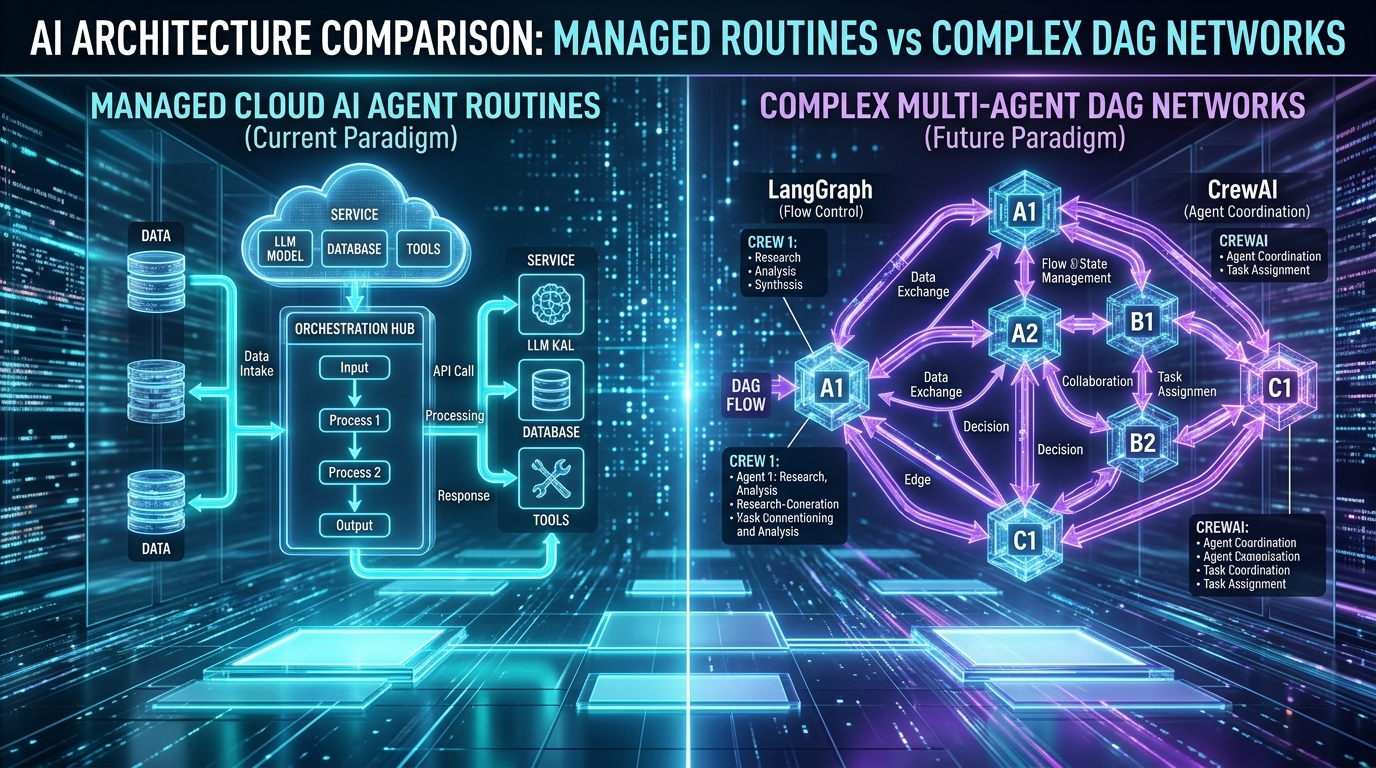
Last updated: 26 August 2026
Key takeaways
- Grok Bot vs CrewAI vs LangGraph is a hosting choice: declarative managed routines versus Python crews versus explicit state graphs.
- LangGraph persists graph state with checkpointers at super-step boundaries; you own Redis/Postgres and retry edges.
- CrewAI documents Crews (role teams) plus Flows (event-driven control plane); you still run the Python runtime.
- Pick a BotSkillsStack routine when the job is a typed Salesforce/Slack write with a dry-run gate, not a custom research DAG.
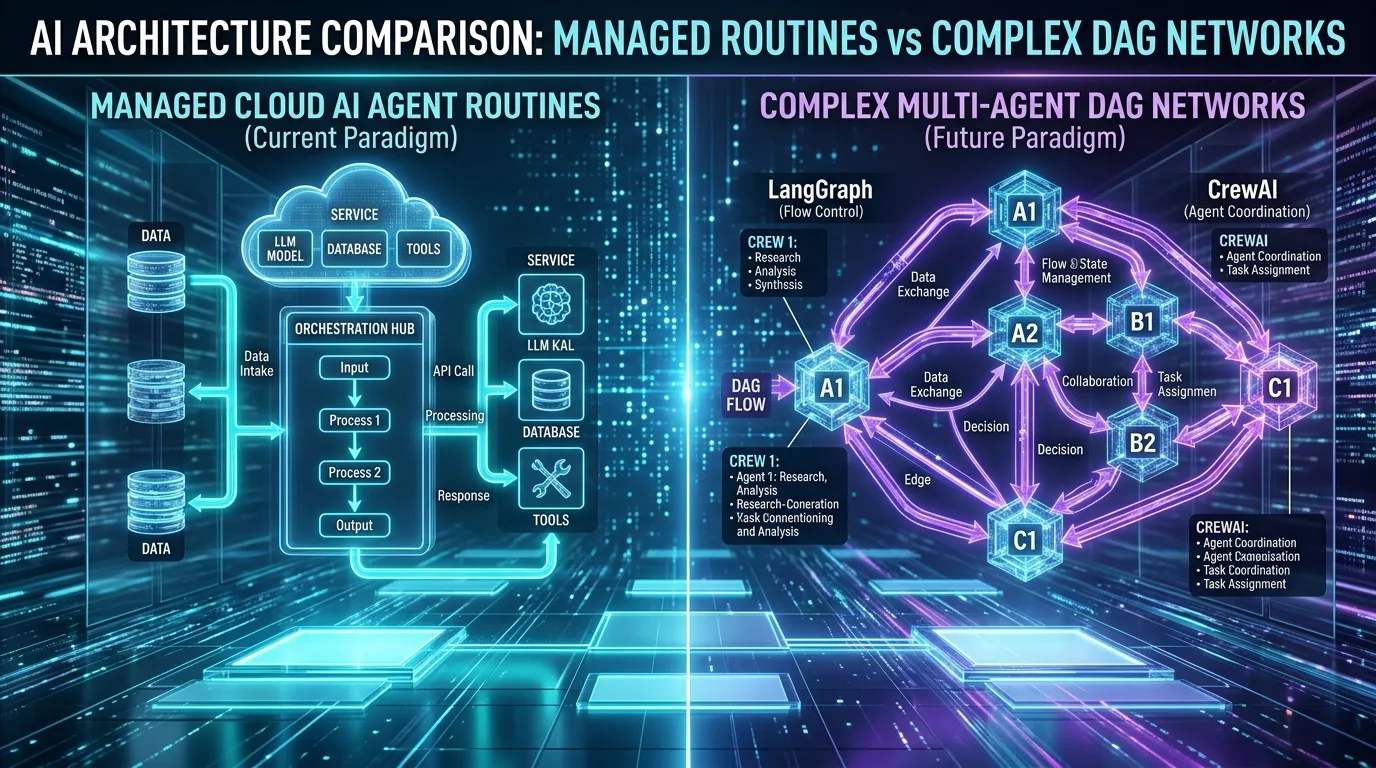
Grok Bot vs CrewAI vs LangGraph is the architectural fork enterprise teams actually search: deploy a managed cloud AI agent routine, or assemble a code-first multi-agent DAG in Python.
When evaluating Grok Bot vs CrewAI vs LangGraph, software architects must weigh developer velocity, failure recovery, state machine persistence, and long-term Total Cost of Ownership (TCO).
In this architectural guide, we break down the fundamental differences between managed cloud routines and code-first multi-agent DAGs.
Architectural paradigms: managed cloud vs code-first Python {#architectural-paradigms}
Framework comparison matrix
| Capability Dimension | Managed Grok Bot Routines | LangGraph (LangChain) | CrewAI Framework |
|---|---|---|---|
| Development Paradigm | Declarative Schema & Prompt Config | Code-First Python State Graphs | Role-Based Python Agent Crews |
| Time to First Production Deploy | Minutes (Zero infrastructure) | Weeks (Custom Python DAG coding) | Days (Role/Task definition) |
| Cyclic Loop & Hallucination Defense | Built-in circuit breakers & guards | Custom conditional edge coding | Built-in retry loops |
| State Persistence & Checkpointing | Managed Cloud Enclave | PostgreSQL / Redis checkpointer | Local memory / ChromaDB |
| Infrastructure Maintenance | Zero server DevOps | High (Worker pods, Redis, Celery) | Moderate (Docker container management) |
| Execution Latency | Sub-50ms TTFT (Native engine) | Variable (Python runtime overhead) | Variable (Sequential agent handoffs) |
| Best Suited For | Standardized Business Operations | Complex Custom Research Pipelines | Collaborative Role-Playing Teams |
Official CrewAI docs describe Flows as the event-driven backbone and Crews as role-playing teams that a Flow can delegate to (CrewAI introduction). That is a different object than a BotSkillsStack typed tools JSON plus dry-run gate.
To explore production-tested enterprise routines that eliminate custom framework overhead, visit our executive AI agent directory and our automated B2B sales bot directory.
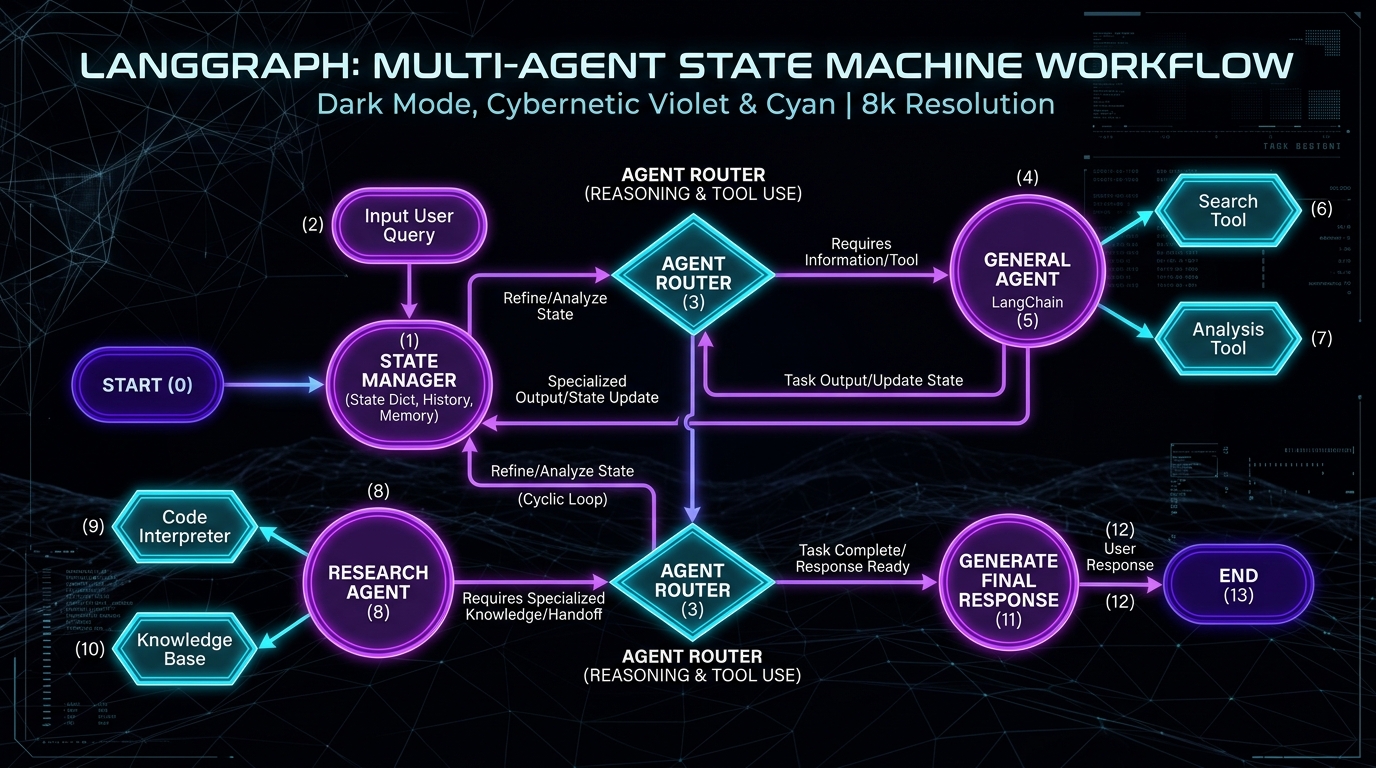
LangGraph state machine orchestration {#langgraph-state-machine}
In LangGraph, developers explicitly define state schemas, node functions, and conditional routing edges. Official persistence docs state that a checkpointer saves a snapshot of graph state at each super-step, organized into threads — that is how you get human-in-the-loop, time travel, and fault-tolerant resume.
from typing import TypedDict, Annotated, Sequence
from langgraph.graph import StateGraph, END

class AgentState(TypedDict):
    input_query: str
    research_data: str
    review_status: str
    attempts: int

def research_node(state: AgentState):
    # Custom tool execution logic
    return {"research_data": "Extracted competitive pricing", "attempts": state["attempts"] + 1}

def router_edge(state: AgentState):
    if state["review_status"] == "APPROVED" or state["attempts"] >= 3:
        return END
    return "research_node"

workflow = StateGraph(AgentState)
workflow.add_node("research_node", research_node)
workflow.set_entry_point("research_node")
workflow.add_conditional_edges("research_node", router_edge)
app = workflow.compile()
While LangGraph offers granular programmatic control, it requires software teams to build and maintain custom retry logic, database checkpointers, API rate-limit queues, and monitoring telemetry.
For a local open-weight alternative rather than a Python DAG, see Grok Bot vs Hermes Agent. For a speaker-by-speaker Python group chat, see Grok Bot vs AutoGen.
Browse verified engineering routines →
Five-year total cost of ownership (TCO) {#five-year-tco}
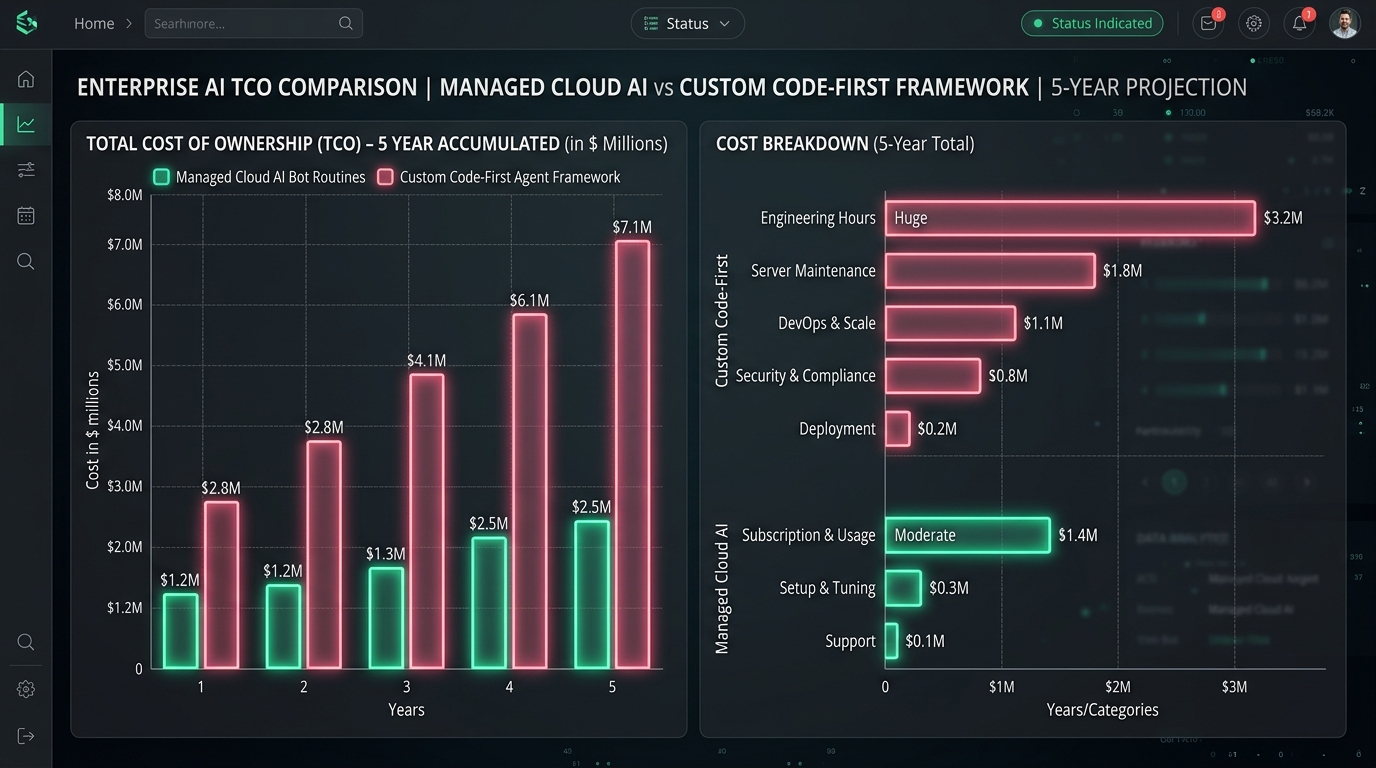
5-year enterprise financial projection (50 active agent workflows)
| Cost Category | Managed Cloud AI Bot Fleet (Grok) | Custom Code-First In-House Framework |
|---|---|---|
| Dedicated Agent Engineers (2 FTEs) | $$0$ (Managed by existing RevOps/IT) | $$2,400,000$ ($$240 ext{k}/ ext{yr} imes 2 imes 5 ext{ yrs}$) |
| Cloud GPU & Server Infrastructure | $$0$ (Included in token pricing) | $$420,000$ (Kubernetes worker clusters, Redis) |
| Inference Token Costs | $$60,000$ ($$1,000/ ext{mo} imes 60 ext{ mos}$) | $$180,000$ (Higher un-cached token overhead) |
| Security & Compliance Audits | $$0$ (Covered by xAI SOC2) | $$150,000$ (Custom penetration tests & audits) |
| Total 5-Year Projected TCO | $\mathbf{$60,000}$ | $\mathbf{$3,150,000}$ |
Strategic recommendation
- Deploy Managed Grok Bot When: You want immediate ROI, zero engineering headcount dedicated to maintaining agent plumbing, and sub-50ms response times for core business operations.
- Deploy LangGraph / CrewAI When: Your workflow requires highly bespoke, non-standard algorithmic DAGs with complex cyclic loops that cannot be represented in declarative schemas.
Inspect ready-to-run enterprise workflows in our executive AI agent directory and deploy with zero custom code.
When to pick each stack {#when-to-pick}
- Grok Bot / BotSkillsStack routine — standardized RevOps, CS, or engineering writes with a JSON schema. xAI function calling is the contract: the model proposes a tool; you execute it.
- LangGraph — you need an explicit
StateGraph, conditional edges, and a production checkpointer you control. - CrewAI — you want role/goal/backstory crews (or Flows wrapping crews) and will operate the Python process yourself.
Inventory: engineering and executive-ops hubs {#inventory-hubs}
Managed Grok routines that replace a custom DAG live in the executive-ops hub (board intel, staffing, operating cadence) and the engineering hub (PR conflict flags, incident runbooks). Mutation-heavy Salesforce jobs should still use two-phase dry-run safeguards.
FAQ {#faq}
Is Grok Bot a drop-in replacement for LangGraph?
No. LangGraph is a code-first graph runtime with checkpointers you host. Grok Bot routines are declarative schemas and prompts on a managed engine.
When should I use CrewAI instead of LangGraph?
CrewAI’s documented unit of work is a Crew of role-playing agents, optionally driven by a Flow. Use it when collaboration roles matter more than an explicit DAG of nodes and edges.
Can I mix Grok function calling with a Python graph?
Yes. Keep graph control in LangGraph or CrewAI, and call xAI tools from a node — but do not give the graph unconstrained CRM write tokens. Preview first.